 Summit Evidence
 Beyond Human-in-the-Loop: Decision Telemetry for Non-Human Entities
For years, data scientists built trust by decomposing probabilistic systems into measurable tasks. That discipline still matters. But once agents act across tools, workflows, and decisions at machine velocity, task telemetry and analysis alone is no longer a sufficient baseline.
For decades, trustworthy AI was built the right way: define the task, instrument the parts, benchmark the flow, and audit the result. That logic still holds for bounded systems.
From collider physics to voice AI, the discipline was the same. Break a probabilistic system into defensible subcomponents, measure each one, and build understanding from the parts up. That is how probabilistic systems became auditable enough to use in the real world.
What has changed is not the value of that discipline. What has changed is the unit of deployment. Agents now route across tools, workflows, and decisions at machine velocity. The number of decision paths grows too quickly for hyper-specified task telemetry to remain the only baseline.
That is the shift leadership teams need to understand. The problem is not whether we can benchmark a task. The problem is whether we can govern non-human decision-making at machine scale.
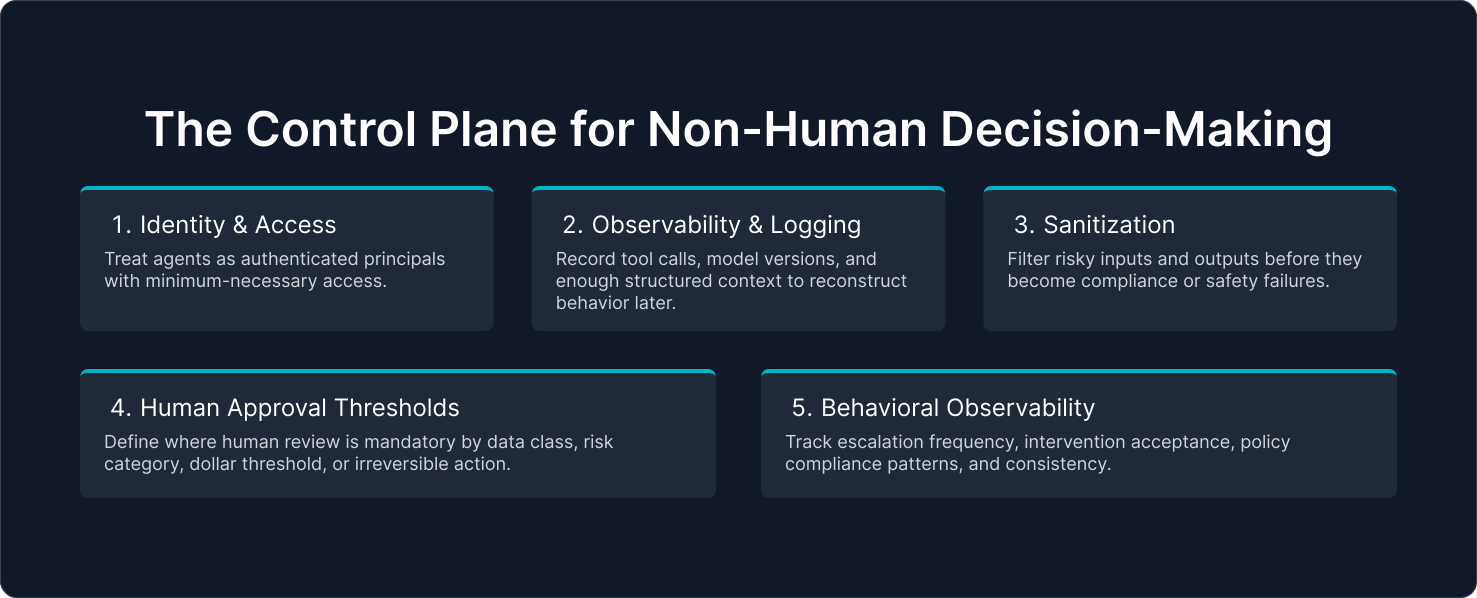
Task-level telemetry still matters, but it no longer scales by itself once agents operate across tools, workflows, and decisions. The new baseline is a control plane for non-human entities: identity and access, observability, sanitization, human approval thresholds, and behavioral observability.
Task Telemetry Is Still the Floor
Nothing about this argument makes task telemetry and analysis less important. In bounded workflows, it is still the right discipline.
Voice AI is a good example. Intent classification, routing correctness, task completion quality, hallucination rate, and guardrail adherence are all real metrics. They are auditable, and they are precisely what make mitigation possible. When a component fails, someone knows which lever to pull — model, prompt, tool access, or guardrail.
That is why task telemetry remains essential. It is how we make probabilistic systems predictable enough to improve, explain, and trust.
But once a system acts across multiple tools and workflows, governance has to extend above the task into a broader control plane. Data scientists were not wrong. The system boundary moved.
The Unit of Governance Has Changed
The right mental model for agents are no longer models performing tasks. It is an entity performing work.
A task-performing model is something you benchmark. An entity performing work is something you govern. You authenticate it. You limit what it can access. You log what it does. You sanitize what goes in and what comes out. You define when human review is mandatory. You hold it to policies that apply to its category of work, not just to one benchmark.
That is what I mean by non-human entity governance. It still depends on classical telemetry and analysis, but it also borrows from zero-trust security, workforce governance, and compliance operations—the same disciplines organizations already use to govern human knowledge workers.
The practical implication is straightforward: if your CISO cannot tell you which models are being called, by which systems, against which data, you do not yet have baseline governance for probabilistic systems.
| What still matters | What no longer scales by itself | What becomes the new baseline |
|---|---|---|
| Task-level benchmarks | Defining every pathway one task at a time | Entity-level identity, access, and observability |
| Human review | Assuming human-in-the-loop alone is enough | Explicit thresholds for intervention |
| Model metrics | Logging model calls without behavioral context | Logging intent, routing, tool use, and outcomes |
| Workflow-specific analysis | Repeating bespoke telemetry for every new agent pathway | A reusable control plane plus crawl-walk-run rollout |
The New Baseline Control Plane
The structure of non-human entity governance looks less like classical ML monitoring and more like governing a fast, capable worker with machine-scale reach.
It requires five control domains.
Identity and access. Every agent should have an authenticated identity and minimum-necessary permissions. Sensitive data should be delivered through authorized deterministic tools, not carried broadly in prompt context. If the agent never sees the credential, it is less likely to leak it.
Observability and logging. Log tool calls, model versions, and enough structured context to reconstruct behavior later. Not every token — just enough to audit the flow, understand the action path, and investigate failure when it matters.
Sanitization. Filter risky inputs and outputs before they become compliance or safety failures. At machine scale, one unfiltered pattern can replicate quickly. The fact that humans often communicate without formal filtering is not a reason to relax this control for agents. It is a reason to require it—from ethical and hate-speech filters to compliance redaction. At machine scale, the risk is not one inappropriate email. It is repeated failure at volume.
Human approval thresholds. Define where human review is mandatory by data class, risk category, dollar threshold, or irreversible action. Human-in-the-loop still matters. But it matters as a threshold-defined control, not as a vague comfort phrase.
Behavioral observability. This is the domain many organizations still underweight. Over time, non-human entities will need the equivalent of knowledge-worker performance review metrics: escalation frequency, intervention acceptance, policy compliance patterns, and consistency across similar inputs.
This is the part that feels unfamiliar to many teams, but it is already operationally necessary. If an agent produces acceptable output one day, drifts the next, escalates erratically, or behaves inconsistently across similar contexts, leaders need a way to see that pattern before it becomes a larger failure.
Non-human entities require something directionally similar, adjusted for the fact that they operate at machine velocity rather than human velocity. This requires a robust set of what I like to call Decision Telemetry.
Why This Matters in Healthcare
Healthcare will feel this shift early because the downside of getting it wrong is larger.
Bias, fairness, and ethics do not disappear in agentic systems; they become harder to manage one task at a time when the same entity moves across many contexts and data domains. For task-level models, the field has built useful approaches: fairness metrics across groups, bias audits on training data, ethical review on defined outputs. Those practices must continue where they apply.
But once a non-human entity crosses tasks, tools, and data domains, per-task ethical measurement becomes much harder to operationalize as the primary control. The human analogy helps here. Organizations do not govern human judgment mainly through continuous bias measurement on every decision. They rely on policy, training, access controls, escalation paths, and after-the-fact review when something goes wrong.
Non-human entities will need a similar architecture: policy enforcement through permissions, sanitization that blocks categorical failures, thresholds for escalation, and auditability when something does go wrong. That is not a lower standard. For systems operating at machine scale across heterogeneous tasks, it is often the more defensible one.
This is why healthcare leaders should think of this as operating-model work, not just AI-policy work. Organizations that treat it as policy work will produce documents. Organizations that treat it as operating-model work will produce controls.
What Leaders Should Build Now
There is no magic bullet here. A pragmatic path looks like this.
Start narrow. Begin with bounded, deterministic use cases where task telemetry is strong and human review is heavy.
Build the control plane early. Use that scope to put identity, access, logging, sanitization, and approval thresholds in place before autonomy expands.
Prove the controls. Validate that the governance layer works before expanding tool access, workflow reach, or decision authority.
Scale deliberately. Let telemetry and governance mature together rather than assuming one can catch up to the other later.
Organizations that deploy agentic systems without this control plane are not moving faster. They are accumulating risk they may not yet be able to explain. Organizations that wait for the problem to be solved by someone else are deferring a capability their competitors are learning to run.
As a scientist, I want to say this plainly: if the field had a widely accepted suite of metrics for evaluating non-human decision-making across these environments — including stronger approaches to quality, bias, and fairness than today’s patchwork of BLEU, ROUGE, and task-specific proxies — I would advocate using it immediately. But those metrics were built for narrower evaluation problems, and even in those domains the literature continues to debate adequacy, replacement, and correlation with human judgment. Bias and fairness evaluation is even less settled. That is exactly why organizations with tool proliferation and agentic activity cannot wait for perfect scientific consensus before building decision telemetry and an effective control plane.
The leadership question is no longer whether task telemetry and analysis matters. It does. The leadership question is whether you are building the governance layer for non-human work.
The framing matters because it changes what leadership teams ask for. Ask only for better benchmarks, and you may get a better report. Build decision telemetry and non-human entity governance, and you may get an operating model that scales.
Further Reading
- NIST AI RMF / Playbook — useful for the broader risk-management framing.
- NIST Zero Trust Architecture — useful for the identity-and-access section.
- OpenTelemetry GenAI semantic conventions — useful if you want one practical pointer on emerging telemetry standards for GenAI.