 Summit Evidence
 My AI Diet: Nobody Knows Everything About AI. Here's What I Do.
I frequently ask audiences a simple question: does anyone here know everything about AI?
I have yet to see a hand go up. Then I ask people to look around the room. Whatever their experience, nobody in it has all the answers.
That is the moment the room exhales.
I spent three years on an AI review board at one of the largest healthcare organizations in the country, where more than a thousand solutions came through evaluation. I also led enterprise AI and data science at a Fortune 3 scale. So let me say it plainly: I do not know everything about AI, and neither does anyone else you are going to meet.
That is not modesty. It is an accurate description of the technology right now.
The Anxiety Is a Category Error
Many people I talk to carry a quiet assumption — that somewhere out there is a body of knowledge about AI they are failing to keep up with, and that perhaps the folks who sound confident already have it.
They don’t. The field is moving faster than anyone’s ability to hold it whole, and the people closest to it understand that better than anyone. What the most informed people have is not a complete picture but a practice.
That distinction matters. A body of knowledge is something you fall behind on. A practice is something you start.
The responsibilities are still real. If AI is part of your work, you need enough understanding to use it responsibly and to recognize when to ask for help. But you can release the pressure to absorb every announcement, and spend that attention on a question that actually matters to you.
That is where I start when I talk about an AI diet.
A body of knowledge is something you fall behind on. A practice is something you start.
What I Actually Do
Here is what I actually do. These are the same four disciplines I enforced at enterprise scale, written the way they work for one person.
| Discipline | For one person | At enterprise scale |
|---|---|---|
| Say what the thing does | Describe the task, not the label | “Non-human entity” instead of “AI,” to force the governance question |
| Isolate before you trust | Test on work where a wrong answer costs nothing | Sandboxed evaluation before production |
| Don’t hand it what you can’t lose | One question asked before pasting | Vendor agreements, data-use review, approval path |
| Check it against what you know | Verify the output against the source | Evidence proportional to the commitment |
Say what the thing does. I often avoid the word AI altogether and introduce myself as a data scientist. When everything is AI, the word stops carrying information. Describing the actual task like summarizing a call, drafting a letter, ranking a list of options, that tells you what to check and whether it worked. The label tells you very little. At enterprise scale I pushed this further and started calling these systems non-human entities, because that phrasing forces the real questions: who authorized it, what can it reach, how do we know what it did.
Isolate before you trust. New tools get tested on work where a wrong answer costs nothing. I ran code assistants in separate, low-stakes workflows well before letting them near anything that mattered. This is the cheapest discipline on the list and the one most people skip.
Don’t hand it anything you cannot afford to lose. I do not put confidential information into tools I have not vetted. In a large organization that becomes a review process with real teeth. For one person it is a single question asked before pasting.
Check it against something you already know. Take a small, real task — turning non-sensitive meeting notes into an action list — and verify the result against the source. Did it preserve who agreed to do what? Did it quietly turn a suggestion into a commitment? A limitation is a useful finding. You now know something specific about where the tool helps and where your judgment is still required.
Those four fit on an index card. Nobody needs a program to run them.
Every Input Does a Different Job
Even good information competes for your attention. Eating well does not mean eating every healthy thing on the menu.
The inputs available to you do different jobs. A common mistake is using every input for the same purpose, which is usually just trying to keep up.
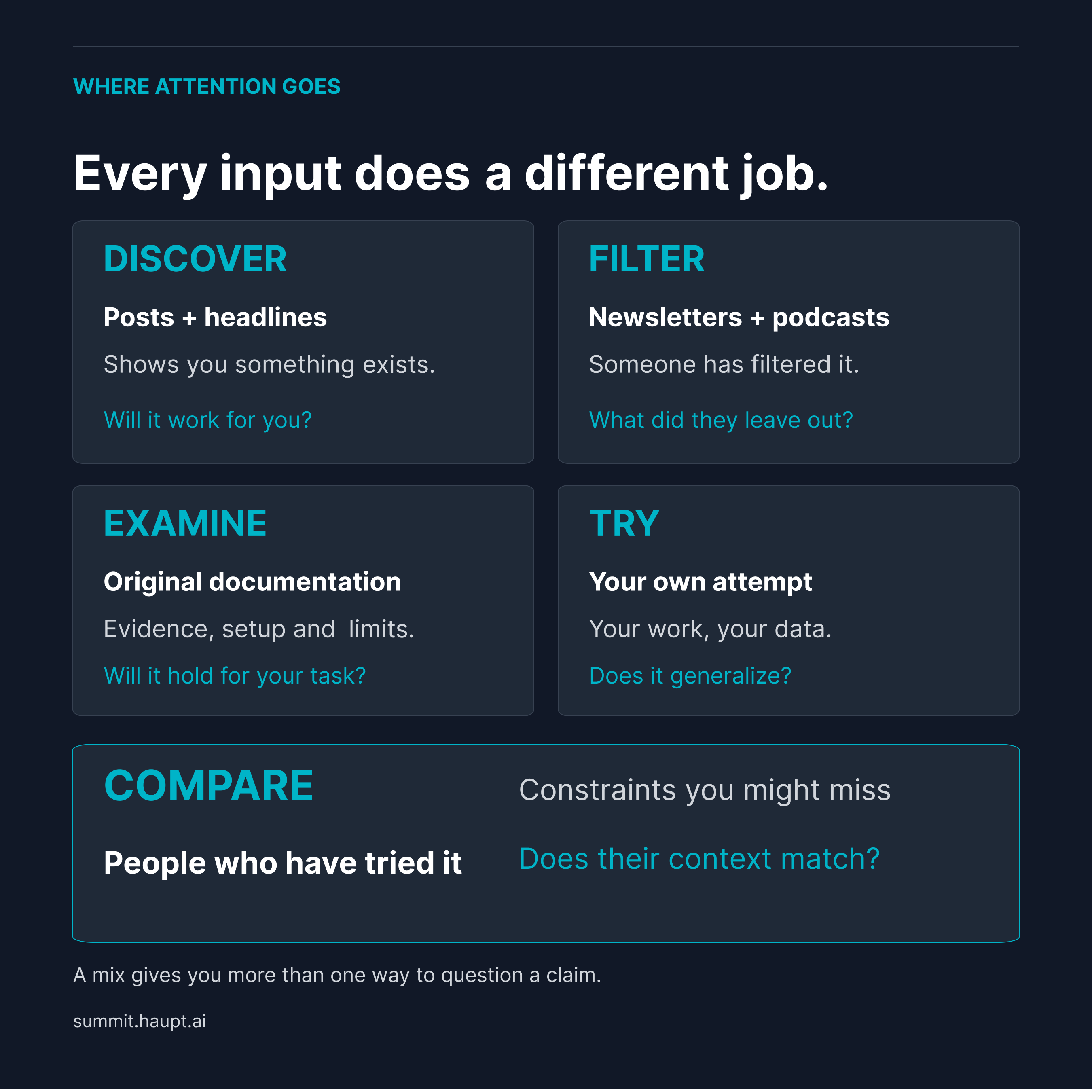
| Input | The job it does | What it cannot tell you |
|---|---|---|
| Posts and headlines | Surfaces that something exists | Whether it works, or whether it applies to you |
| Newsletters and podcasts | Helps you make sense of it — someone has already filtered | What they left out, or where they are wrong |
| Original documentation and research | Tells you what was actually tested, and under what conditions | Whether it holds in your environment |
| Your own small attempt | Tells you what happens with your work, your data, your constraints | Whether it generalizes past you |
| People who have tried it | Surfaces the constraint you did not know to ask about | Whether their context matches yours |
Read the lat part on its own and the case for an input mix becomes concrete. Each input’s blind spot is another input’s job. A headline cannot tell you whether something works; documentation and your own attempt can. Documentation cannot tell you whether it holds in your environment; only trying it can. Your own attempt cannot tell you whether it generalizes; someone who else has tried it can.
A diet of only headlines keeps you current and unable to act. A diet of only documentation makes you thorough but possibly slow.
That is what a mix is for. Coverage.
So bring a question. For a founder it might be a customer interaction. For an executive it might be a capability the organization is weighing. For anyone, it might be an ordinary task they would just like to make easier.
Pick one question from your own work, and one or two inputs that help you explore it. Choose sources that explain their reasoning and name their limits. Go deeper when a claim could affect a decision that matters.
Put People in Your AI Diet
I would be describing a diet I do not eat if I stopped at coverage. My attention is not spread evenly across those five rows, and it has not been for a long time.
Most of what I have learned about AI in the past two years came from asking people questions. Not from reading what they published but from asking what they tried, what broke, and what they would not do again.
There is a structural reason for that. Publishing selects for a particular kind of information: what someone had a reason to write down. The parts that would most change your decision, the constraint nobody anticipated, the workflow that quietly did not survive contact with real users, the result that worked for reasons the team still cannot explain, rarely come with that reason attached.
The information that would most change your decision is usually the information nobody had a reason to publish.
So that is where the weight goes. This is the input most people skip, and it is the one I lean on hardest.
A colleague may see a workflow constraint you missed. A peer may have already tested the tool you are still reading about. For leaders, listening to the people doing the work is part of staying informed, not a courtesy you extend.
Trust is what lets you ask an unfinished question. Different perspectives are what let you examine the answer. A useful group needs room for disagreement and a willingness to go back to the evidence. Familiarity alone cannot tell you whether a claim is sound.
This can be small. A coffee with a peer. A local meetup. A thread in a channel your coworkers already use.
Bring something specific: a question, an attempt, or an observation. Ask what the other person tried, what they checked, what surprised them, and what they would still question.
Then make your own learning easy to pass along: what I tried, what I checked, what I learned, what remains open. Give someone enough context to use it or to argue with it.
What I tried. What I checked. What I learned. What remains open.
Start This Week
One question you care about. One input that helps you explore it. One person to compare notes with. Run a small attempt, and write down a short lesson you can give back.
If you want the enterprise version of this argument — the same disciplines as an operating model rather than a personal practice — that is AI Transformation Is Still Transformation.
Nobody has the complete picture. What the most informed people have is a practice, and yours can start right now.
A note on the metaphor: the information-diet idea predates the current AI moment. Clay A. Johnson explored it in The Information Diet (O’Reilly, 2012). This piece applies that metaphor to my own work with AI, practical curiosity, and shared learning.