 Summit Evidence
 The Four Pillars of Healthcare AI Transformation
The healthcare organizations making real progress with AI are not the ones running the most experiments. They are the ones building an operating model for intake, readiness, governance, and execution.
Across the conversations I’m having with healthcare leaders right now, the pattern is surprisingly consistent: there is no shortage of AI ambition, vendors, or pilot ideas. What is often missing is the operating model that turns all of that motion into something real—something that can survive compliance review, workflow adoption, financial scrutiny, and production pressure. In healthcare, enterprise AI transformation is not just about model performance. It is about building the systems, boundaries, and leadership discipline that let the right use cases move from interest to impact.
The Real Challenge: Production, Not Possibility
Healthcare has moved past the point where AI strategy can be confused with AI enthusiasm. Most organizations can point to experiments, vendor conversations, or a set of pilots scattered across operations, clinical workflows, member experience, or product teams. That may create activity. It does not yet create transformation.
Transformation happens when an enterprise can repeatedly answer the same set of questions well. Which use cases actually matter? Which ones are safe enough and valuable enough to move now? Who decides? Who owns the outcome? Where is a human-in-the-loop required? How is PHI handled? What happens when the model underperforms, drifts, or creates operational friction? And who has the authority to make those answers stick across the organization?
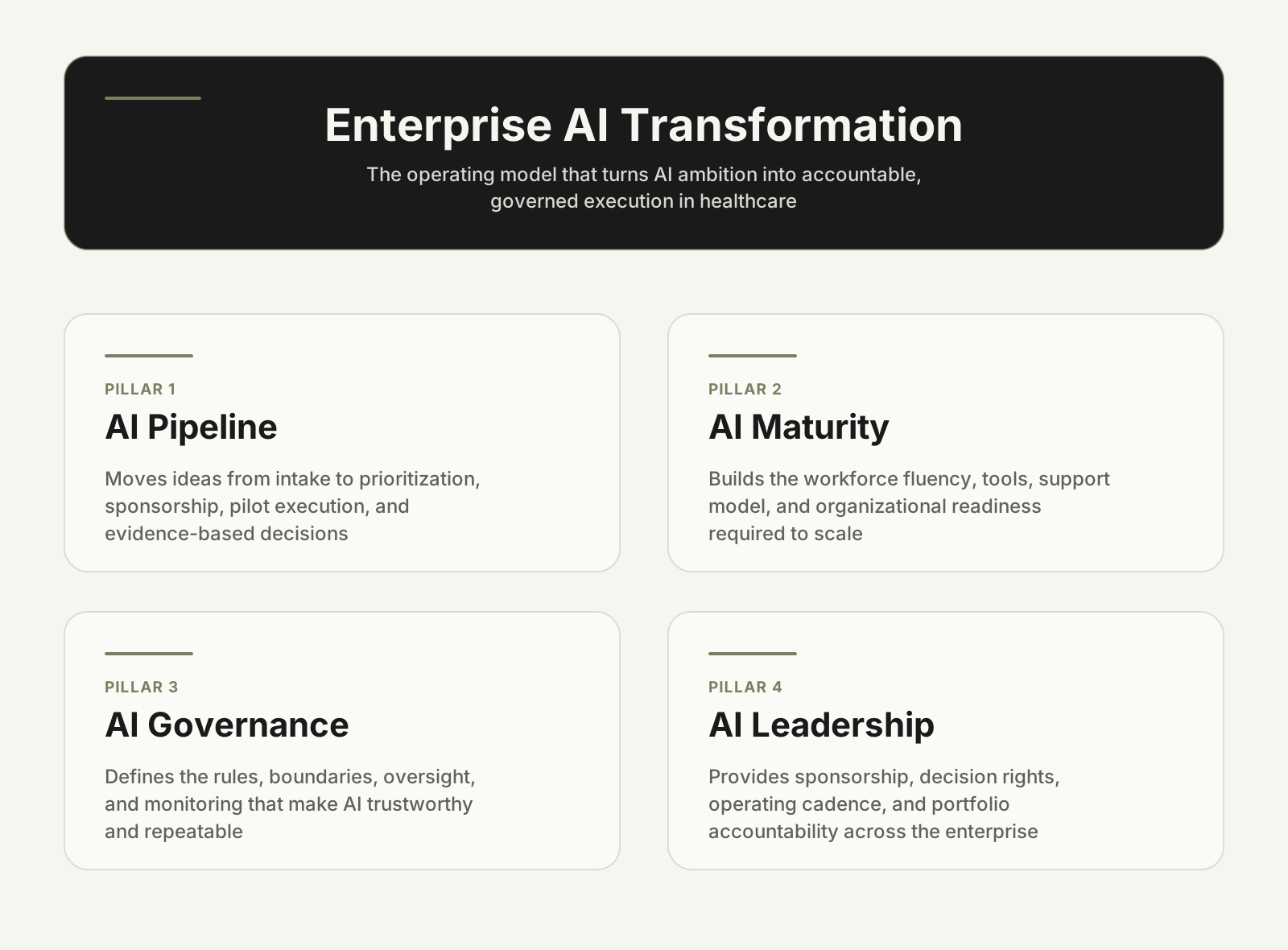
That is why this framework is not theoretical. It is an operating model. The healthcare organizations making the most durable progress tend to converge on four pillars: AI Pipeline, AI Maturity, AI Governance, and AI Leadership. None of these exist in isolation. Together, they form the conditions that let AI move from a promising demo to a real enterprise capability. These aren't new concepts.
CEOs, CIOs, CAIOs, CDOs, CMIOs, and operations leaders trying to move AI from scattered pilots into governed, measurable execution.
| AI Pipeline | The system that moves AI from idea to accountable execution. This includes intake, evaluation, prioritization, lighthouse workflow selection, pilot approval, KPI ownership, and the decision to scale, refine, or retire a use case based on evidence. |
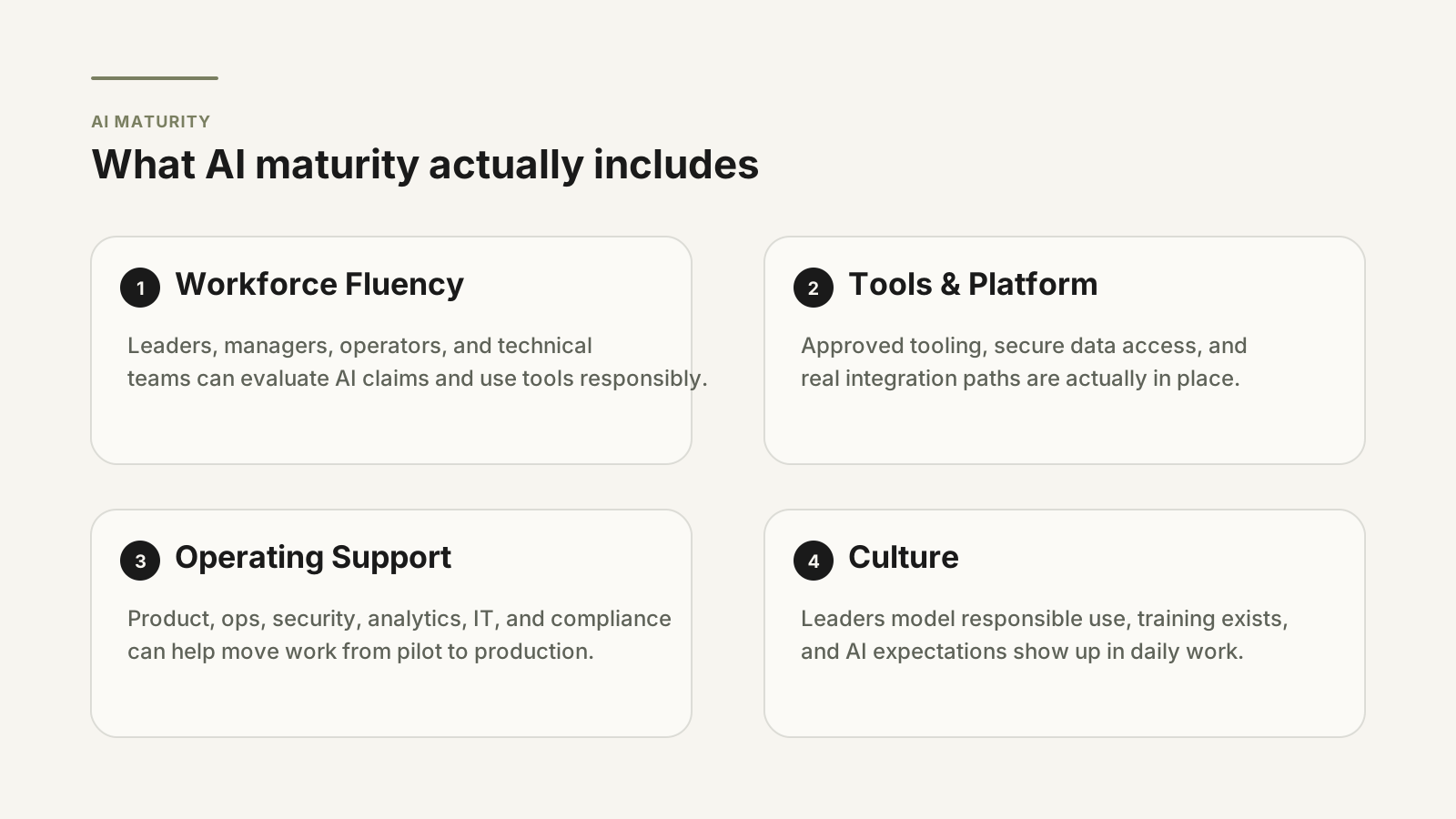
| AI Maturity | The organization’s ability to actually absorb and scale AI. This includes workforce fluency, approved tools, training, staffing mix, cross-functional support, and the cultural readiness required to move beyond isolated experiments into repeatable enterprise adoption. |
| AI Governance | The rules of engagement that make AI safe, trustworthy, and repeatable in practice. This includes human-in-the-loop requirements, PHI handling, vendor scrutiny, approval paths, monitoring, auditability, and the operational boundaries that determine where AI can and cannot be used. |
| AI Leadership | The leadership function that gives enterprise AI direction, authority, and executional discipline. This includes portfolio ownership, decision rights, operating cadence, executive communication, and the accountability required to move AI from scattered pilots to measurable business outcomes. |
A recent systematic review in npj Digital Medicine synthesized the healthcare AI implementation literature into seven recurring governance domains. My four pillars compress those domains into a structure leaders can use to prioritize work, govern risk, and execute with accountability.
For readers who want more detailed reference frameworks, NIST AI RMF is strong on risk structure, CHAI is strong on trustworthy-AI assurance, and FAIR-AI is strong on practical health-system review and monitoring. This article is designed to complement those frameworks, not duplicate them.
| Pillar | HAIRA governance domain + others |
| AI Pipeline | Problem formulation, External algorithm evaluation and selection, Deployment and integration |
| AI Maturity | Algorithm development and training. talent, tooling, data/platform readiness |
| AI Governance | Model evaluation and validation, Monitoring and maintenance, risk, compliance, transparency |
| AI Leadership | Organizational structure, Executive sponsorship, decision rights, cadence, accountability |
Two enabling layers support all four pillars
Data & Platform Foundation and Monitoring & Assurance layers support all pillars. I do not treat them as separate pillars because they cut across the whole operating model, but nothing moves to production without them.
Data & Platform Foundation covers approved tooling, secure access, interoperability, integration paths, and the technical environment required to ship safely. Monitoring & Assurance covers validation, transparency, auditability, performance review, and post-deployment checks.
Pillar 1: AI Pipeline — From Idea to Impact
Most organizations already have more AI ideas than they can responsibly ship. The scarcity is not imagination, its structure.
A real AI pipeline gives leaders a disciplined way to capture ideas, evaluate them, compare them, prioritize them, approve them, and then measure whether they delivered what was promised. Without that system, intake happens through hallway conversations, vendor demos, pure enthusiasm, and uneven local experiments. The result is predictable: the loudest idea gets attention, while the best idea is often ignored.
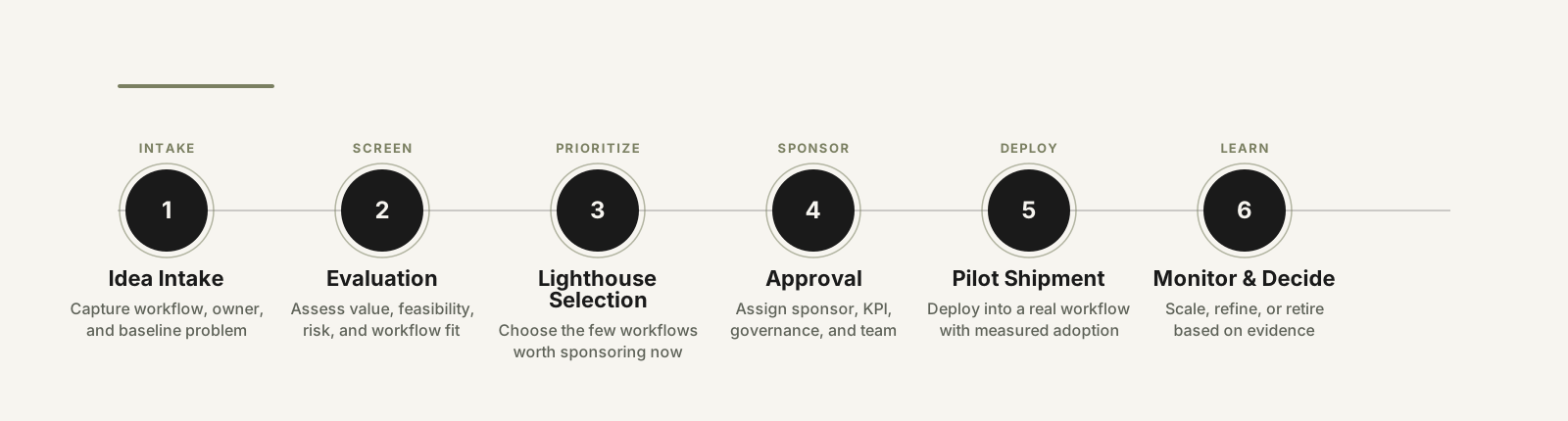
A strong pipeline begins with intake, but it cannot end there. It should force a few questions early. What exact workflow is being changed? Who is the user? What decision, recommendation, or task is AI touching? What baseline metric exists today? What is the expected value if it works? What is the risk if it fails? Where does human review sit? What systems will it have to integrate with? Who is the operational owner? Who is the financial owner? And who is actually responsible for shipping the pilot?
This is also where leaders select lighthouse workflows. They might not be flashy but the value is meaningful, risk is manageable, and adoption has a fair chance of succeeding. In many healthcare settings, that means looking for places where AI can reduce burden, improve throughput, strengthen quality, or accelerate routine decisions without overstepping into ambiguous autonomy.
AI Pipeline means: which use cases get funded now
The pipeline is also where accountability becomes real. A pilot should not be approved without clear decision rights, a named sponsor, an assigned team, a baseline KPI, and an agreed measurement window. Good pipelines do not just help organizations say yes faster. They help organizations say no more intelligently. They keep the portfolio from turning into a list of disconnected experiments.
Pillar 2: AI Maturity — Can the Organization Actually Absorb AI?
AI maturity is not a measure of enthusiasm. It is the organization’s ability to absorb AI safely, repeatedly, and at production depth.
In practice, I look at four dimensions: workforce fluency, tools and platform, operating support, and culture. Workforce fluency is whether leaders, managers, operators, and technical teams know enough to evaluate AI claims and use approved tools responsibly. Tools and platform are whether the approved tooling, secure data access, and integration pathways are actually in place. Operating support is whether product, operations, security, analytics, IT, and compliance can help move work from pilot to production. Culture is whether leaders model responsible use, training exists, and AI expectations show up in how the organization actually works.
The constraint varies by organization. In some cases, the gap is technical depth. In others, it is product ownership, workflow redesign, or the lack of operating support around implementation. Often, the biggest weakness is manager-level fluency: leaders who are accountable for outcomes but do not yet know how to evaluate AI claims, sponsor the right use cases, or coach teams through adoption. That is not a small issue. It is often the difference between enterprise traction and stalled pilots.
Low-maturity environments usually fail in one of two ways. AI becomes over-centralized, where one team becomes the bottleneck for everything, or it becomes fragmented into shadow AI, where teams start experimenting without shared standards. Neither scales well. The goal is not to turn every employee into a model builder. The goal is to make the organization capable enough, at multiple layers.
Pillar 3: AI Governance — The Rules of Engagement
Governance is the pillar most leaders acknowledge and least leaders fully operationalize.
Many organizations have policy language. Far fewer have governance that operates in practice. In healthcare, that distinction matters. Governance is not a document that sits on a shared drive. It is the set of rules, reviews, boundaries, approvals, monitoring practices, and escalation paths that shape how AI is actually used across the enterprise.
It starts with boundaries. What will the organization not do with AI? Where is a human in the loop mandatory? Which decisions can AI support, and which decisions can it never make on its own? What are the crawl, walk, run decisions the enterprise is making about autonomy, evidence, and risk? In some settings, the right near-term posture may be clear: avoid negative decisions without human oversight, while allowing AI to support positive, assistive, or efficiency-oriented actions under tighter controls.
Good governance also forces clarity around what the organization is not willing to break. Trust. Auditability. Privacy. Workflow safety. Explainability where it matters. The answer may vary by use case, but the discipline of deciding matters more than pretending every use case carries the same level of risk.
Then governance extends outward to vendors. This is where many teams lose time, or worse, sign up for problems they only discover later. Leaders need a repeatable way to ask the right questions. How is PHI handled? What is the actual boundary between the vendor environment and the enterprise environment? Is there a real audit trail? What does evaluation look like before production? How does pricing behave at production scale, not demo scale? Does the solution live in a standalone portal, or does it integrate into the workflows and systems the enterprise has already chosen?
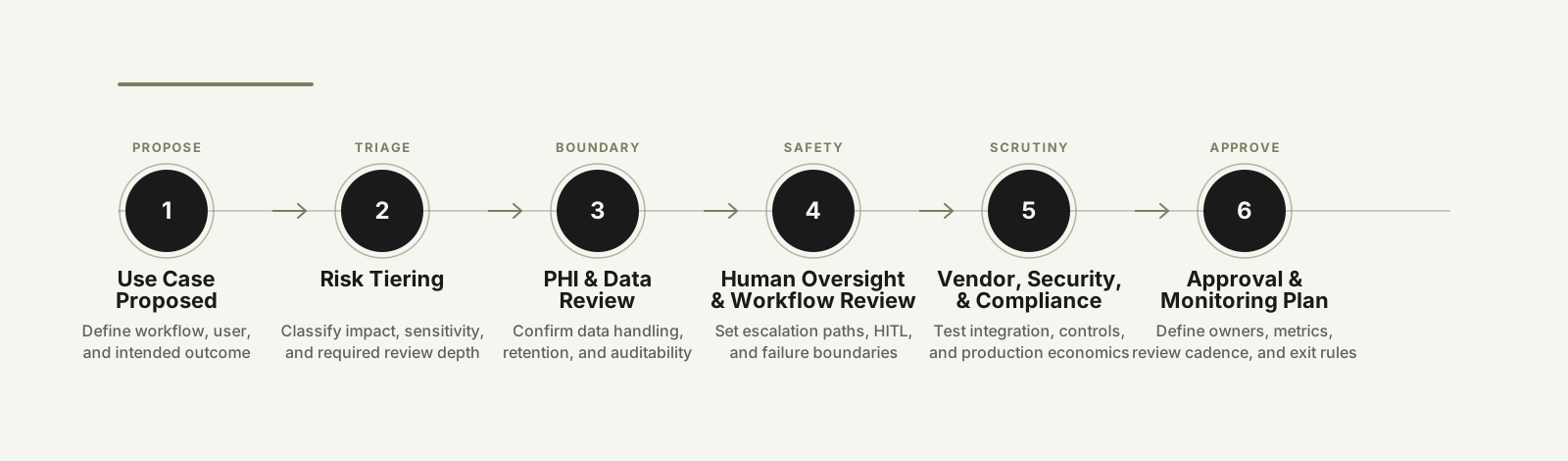
This is where vendor red flags surface quickly:
- “Trust us” safety claims without evidence
- No clear PHI boundaries or audit trail
- A vague evaluation story
- Pricing that breaks at production volume
- A workflow that depends on a standalone portal instead of enterprise integration
Strong governance does not slow transformation down. In high-stakes environments, it is what makes speed survivable. Good brakes are what let organizations move with confidence. Bad or absent governance creates the opposite: every new use case becomes an argument from scratch, every vendor conversation becomes an exception process, and every pilot carries hidden risk into production.
Pillar 4: AI Leadership — The Function That Makes It Real
The fourth pillar is AI leadership, and it is the one that makes the other three real.
The title may vary. In one organization it may be a Chief AI Officer. In another it may sit with the Chief Data Officer, CIO, product leadership, operations leadership, or a transformation executive. The title matters less than the function. Someone has to own the portfolio, the cadence, the executive narrative, and the translation layer between strategy and execution.
That leadership function is not just there to inspire the organization or take vendor briefings. It is there to make decisions stick. It ensures that governance is live and enforced, that the pipeline is active and credible, that maturity gaps are being addressed, and that the enterprise is not just talking about AI at the leadership level but actually executing toward outcomes.
This is where operational cadence matters. How often is the AI portfolio reviewed? Who approves new pilots? Who tracks adoption? Who owns the ROI conversation? Who decides whether a vendor stays, expands, or gets cut? Who communicates to executives, managers, and front-line teams what the organization is doing and why? Who keeps the narrative honest when a pilot works, and equally honest when it does not?
Pipeline ≠ Spreadsheet, Matruity ≠ training slide, Governance ≠ legal memo
Without this pillar, the others degrade into artifacts. The pipeline becomes a spreadsheet. Maturity becomes a training slide. Governance becomes a legal memo. Leadership is what turns these into a system. It is what keeps the organization aligned when tradeoffs get hard, when adoption is slower than expected, when a promising vendor does not survive scrutiny, or when a use case that looked exciting turns out not to matter enough to scale.
None of These Pillars Exist in Isolation
This is the part many organizations underestimate: these pillars are deeply connected.
Take a workflow like contact-center agent assist, prior authorization guideline processing, or clinical operations inbox triage. The pipeline determines whether it is a true lighthouse workflow and defines the KPI that matters. Maturity determines whether the team has the tools, training, workflow ownership, and organizational fluency to absorb it. Governance defines PHI handling, escalation, auditability, review requirements, and vendor constraints. Leadership ensures that the workflow is sponsored, measured, communicated, and either scaled or retired based on evidence.
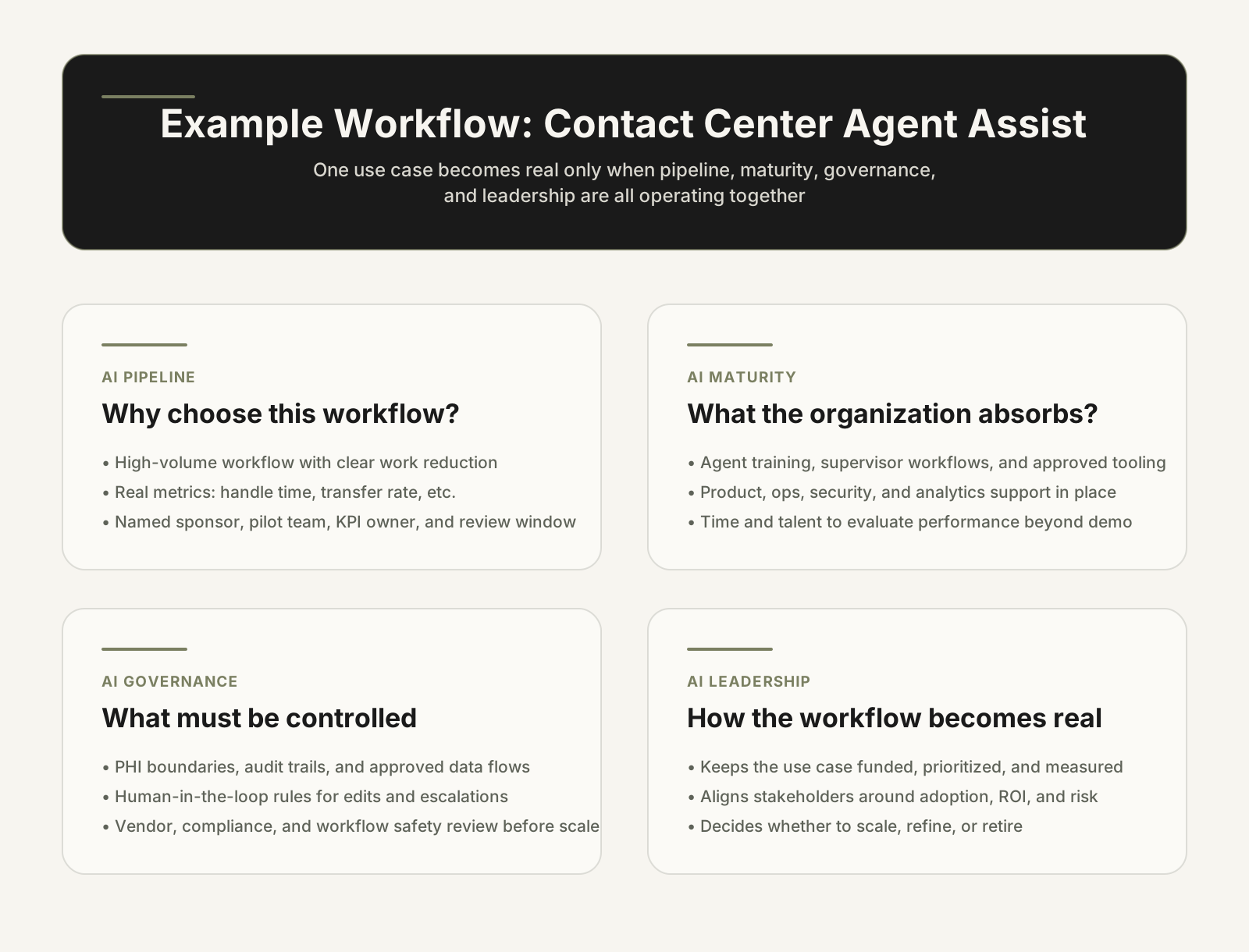
That is why weakness in one pillar quickly shows up as failure in another. Pipeline without maturity produces overloaded teams and stalled pilots. Maturity without governance produces shadow AI and inconsistent risk. Governance without leadership produces delay and ambiguity. Leadership without pipeline produces theater. The organizations that move well are the ones that understand enterprise AI transformation as a system, not a set of disconnected initiatives.
Final Thought
Healthcare organizations do not need more AI theater. They need an operating model.
The four pillars are not extra work surrounding AI transformation. They are the work. A disciplined pipeline helps the enterprise choose the right opportunities and assign real accountability. AI maturity gives the workforce and operating model the capacity to absorb the change. Governance defines the rules that protect trust while making execution repeatable. Leadership provides the authority and cadence that keep all of it moving.
That is how AI becomes real in healthcare. Not through one more demo. Not through one more vague innovation strategy. Through an enterprise system that can repeatedly choose, govern, ship, measure, and improve the right work.
In healthcare, that is what transformation looks like.